Written by: Linda Chen
Last updated on: August 10th, 2026
Why BC Summers Now Come with a Mandatory Smoke Season
It wasn’t always like this. A decade ago, a smoky day in the Lower Mainland was a rare fluke. Now, it feels like an annual season of its own. From the coastal valleys of Squamish all the way down through Coquitlam, Burnaby, Surrey, Langley, and Delta, we’ve all had to get used to checking the local air quality index before we even open our blinds in July.
The real culprit behind those orange skies is PM2.5. These are microscopic soot particles that are 2.5 microns or smaller. Because they are so tiny, they slip right past your body’s natural defenses—like the hairs in your nose—and travel deep into your lungs, eventually making their way into your bloodstream. That’s why smoky days leave you feeling congested, trigger asthma flare-ups, and make everyone’s eyes burn. If we want to keep our families safe, we have to start thinking about our indoor spaces as our primary shield.
Interface Fires: Why Modern Smoke is Way More Dangerous Than Campfires
There is a big myth that wildfire smoke is just natural forest ash. But when fires burn through neighborhoods—what the pros call the wildland-urban interface (WUI)—we are breathing in something far worse.
Think about what burns when a fire hits a populated area. It’s not just pine needles. It’s vinyl siding, car batteries, copper wiring, household plastics, roofing materials, and chemical cleaners. A landmark study on this hybrid smoke revealed that it contains a highly toxic chemical cocktail :
- Microscopic heavy metals that hitch a ride on tiny soot particles.
- Polycyclic aromatic hydrocarbons (PAHs) at ten times normal levels.
- Benzene and other volatile organic compounds linked to cancer.
- Persistent synthetic chemicals, often called “forever chemicals” (PFAS).
Standard air quality monitors often miss this chemical danger because they only weigh the total amount of dust in the air, completely ignoring what that dust is made of. This means even on days when the air quality index looks relatively moderate, the air you breathe could still be carrying toxic chemicals.
How Vancouver’s Hills and Valleys Trap the Smoke
The smoke doesn’t hit every part of the Greater Vancouver Area the same way. Our geography creates stubborn little microclimates that behave quite differently:
- Langley, Surrey, and Delta: You are sitting in the flat basin of the Lower Fraser Valley. On hot summer days, a layer of warm air acts like a heavy lid, trapping soot and ground-level ozone close to the valley floor. The smoke often pools here long after coastal winds have cleared out Vancouver’s core.
- Burnaby and Coquitlam: The mountains here create a thermal slide. At night, cold air flows down the slopes, pinning the smoky air flat against the valley floor. You might wake up to incredibly thick, choked air that slowly burns off by noon.
- Squamish: Up in the Sea-to-Sky, you are at the mercy of valley wind currents. A southerly ocean breeze can keep the air beautifully clean, but if the wind flips north, it can funnel thick mountain smoke down the passes and fill the valley in just an hour or two.
Because our local weather can change so quickly, you need a reliable way to seal up your home before a smoke wave hits.
The Airtight Home Dilemma: Why Ventilation Can Work Against You
If you live in a newer BC home, it is probably built to meet strict energy standards like the BC Energy Step Code. Your home is wrapped tight to stop drafts and save on heating bills.
But here is the catch: a super-sealed home traps every bit of indoor pollution you create. Under normal conditions, indoor air is actually two to five times dirtier than outdoor air due to cooking fumes, cleaning sprays, carbon dioxide, and furniture chemicals.
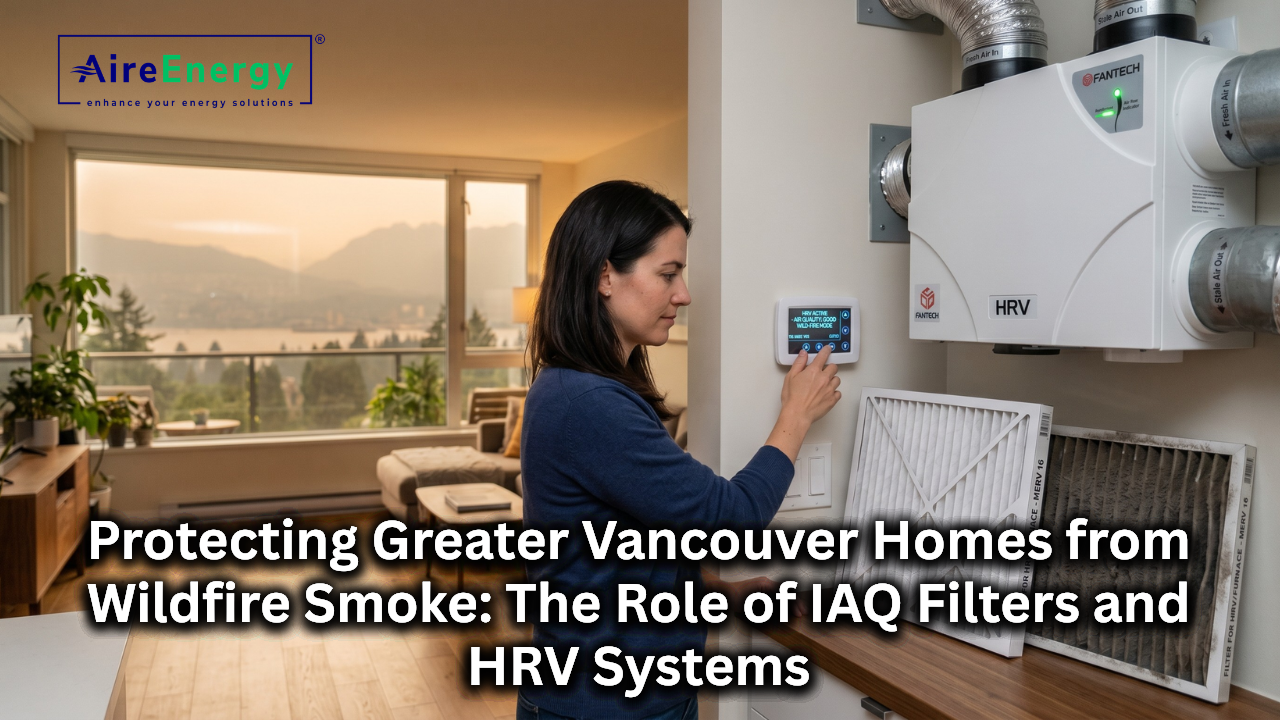
To keep you breathing, modern homes use mechanical ventilation. This is usually handled by a Heat Recovery Ventilator (HRV) or an Energy Recovery Ventilator (ERV).
- HRVs are the standard in our damp, coastal climate because they keep fresh air moving while kicking out dampness to prevent winter mold.
- ERVs do a similar job but hold onto a bit more indoor moisture, which is great if your home gets overly dry in the winter.
Under normal circumstances, these systems are fantastic for keeping your home healthy. But during a wildfire, they present a major challenge by drawing highly toxic outdoor smoke directly inside.
How to Run Your HRV When the Smoke Hits
Do not just leave your system running like normal when the sky turns orange. Here is your playbook :
- Switch to Recirculation Mode: Check your system’s wall control. If you have a recirculate setting, flip it on immediately. This shuts the outside dampers but keeps the internal fan running. It will continually pull the air already in your house and push it through the system’s filter without bringing in outdoor smoke.
- Shut It Down: If your system doesn’t have a recirculate setting, you should turn the HRV off completely. Leaving it on will fill your home with soot. Just remember to turn it back on to flush out built-up carbon dioxide and moisture once the outdoor air clears up.
The Bathroom Fan Vacuum Effect
This is a classic building science trap: you turn off your HRV, close your windows, and think you are safe. But then you turn on your kitchen range hood to fry dinner, run your clothes dryer, or turn on your bathroom exhaust fans.
All that air being pushed out has to come from somewhere. It creates negative pressure inside, essentially turning your home into a giant straw. Outdoor smoke gets sucked in through tiny cracks around windows, door sweeps, and wall outlets to balance the pressure.
To avoid this, try to use your high-volume exhaust fans as little as possible on smoky days. Also, consider upgrading leaky, old bathroom fans to tightly sealed, modern ones.
If you are in the Greater Vancouver Area, there is a massive government program right now. Homeowners can get up to $2,400 in subsidies that cover the entire cost of a new, energy-efficient exhaust fan and professional installation through AireEnergy. It is a simple, free upgrade to protect your indoor air pressure and keep drafty smoke out.
Furnace Filters: Demystifying MERV Ratings
If you have a central furnace or a ducted heat pump, your filter is your first line of defense. But you need to know what you are buying :
- MERV 1 to 4: Standard cheap fiberglass filters. These only protect your furnace fan from giant dust bunnies and hair—they trap less than 5 percent of actual smoke.
- MERV 5 to 11: Good for pollen and pet dander, but they still let most micro-soot pass right through.
- MERV 13 to 16: This is the sweet spot for wildfire protection. A MERV 13 filter captures about 90 percent of those dangerous PM2.5 particles.
But do not just run out to the store, buy a thick MERV 13 filter, and jam it into a system designed for a thin MERV 4 filter. High-efficiency filters restrict airflow. If your system’s blower motor has to fight too hard against a dense filter, it can overheat, blow your motor, and spike your energy bill. Always have an HVAC technician check what rating your system can safely handle.
Particulates vs. Gases: Why HEPA and Carbon are Partners
Even a MERV 13 or a certified True HEPA filter (which traps 99.97 percent of tiny particles) has a blind spot. They only catch solid soot. They cannot trap the actual chemical gases or the burning smell.
To get rid of that heavy, acrid campfire smell and toxic VOCs, your air needs to run through a thick bed of activated carbon.
If you want a set-and-forget solution, you can have a whole-home bypass air purifier (like the Lennox PureAir) integrated directly into your central ductwork. These systems use a mix of deep filtration and carbon media to scrub the air in every single room silently, without choking your furnace’s airflow.
What About DIY Box Fan Filters?
We’ve all seen the tutorials online: strap a MERV 13 filter to a cheap box fan. These do-it-yourself setups (like the Corsi-Rosenthal box) are actually tested and proven to work in a pinch. Safety tests even show they don’t pose a fire hazard if your fan is in good shape.
But they have some annoying real-world drawbacks :
- They drop in performance fast: Once the filter gets coated in sticky smoke, its clean air delivery rate can plummet by up to 95 percent, meaning you have to change the filters constantly.
- They are loud: Running a box fan on high in your living room sounds like a jet engine taking off, ranging from 55 to 75 decibels.
- No chemical protection: Unless you buy specialized, expensive carbon sheets, they won’t stop the toxic gases or the smell.
A permanent HVAC upgrade—like a central ducted heat pump paired with proper media filtration—gives you year-round heating, cooling, and silent air scrubbing while qualifying you for great provincial rebates.
Your Wildfire Smoke Game Plan
When the air quality warnings go out, here is exactly what you should do :
- Lock down the house: Close all windows, doors, and fireplace dampers immediately.
- Set your fan to ‘ON’: Switch your thermostat from “AUTO” to “ON”. This keeps your furnace or heat pump fan running continuously, constantly cleaning your indoor air even when the system isn’t actively heating or cooling.
- Keep it cool: Try to keep your indoor temperature under 26 degrees Celsius to prevent heat stress. Running your AC or heat pump is completely safe because they only recirculate your indoor air—they do not draw air from the outside.
- Watch your filters: Smoke loads filters incredibly fast. Check your furnace or purifier filters monthly during the summer, and replace them every 1 to 3 months when it’s actively smoky.
Get Some Local Expertise on Your Side
Getting your home’s air flow right is a delicate balancing act. If you want to make sure your home is actually prepared for the next smoke storm, the team at AireEnergy is here to help.
We operate out of our Richmond office at 8-3331 Viking Way and service the entire Lower Mainland. Whether you need baseline air quality testing, an HRV inspection, or want to look into an energy-efficient heat pump upgrade that keeps you cool and clean, we focus on honest advice and zero high-pressure sales.
Call us at 778-601-7872 or 778-838-8046 to chat about your home’s setup and see what provincial rebates you qualify for today.
